

Summary
The US private credit market is under unprecedented stress. Fitch Ratings recorded a 9.2% default rate in its Privately Monitored Ratings (PMR) portfolio in 2025 — a record high, up from 8.1% in 2024. Major credit funds including Blue Owl, Morgan Stanley, Cliffwater, and BlackRock have restricted or frozen investor withdrawals, evoking comparisons to early warning signs that preceded the 2008 Global Financial Crisis.
Domestic Private credit funds have argued that India’s private credit ecosystem is structurally insulated from this contagion. While this thesis has broad merit, a more granular examination reveals important qualifications. This note presents the core thesis of Indian Private Credit Funds, constructive counter-perspectives, latest market data, and a nuanced assessment of where Indian private credit genuinely diverges from its US counterpart — and where caution remains warranted.
Key Takeaway
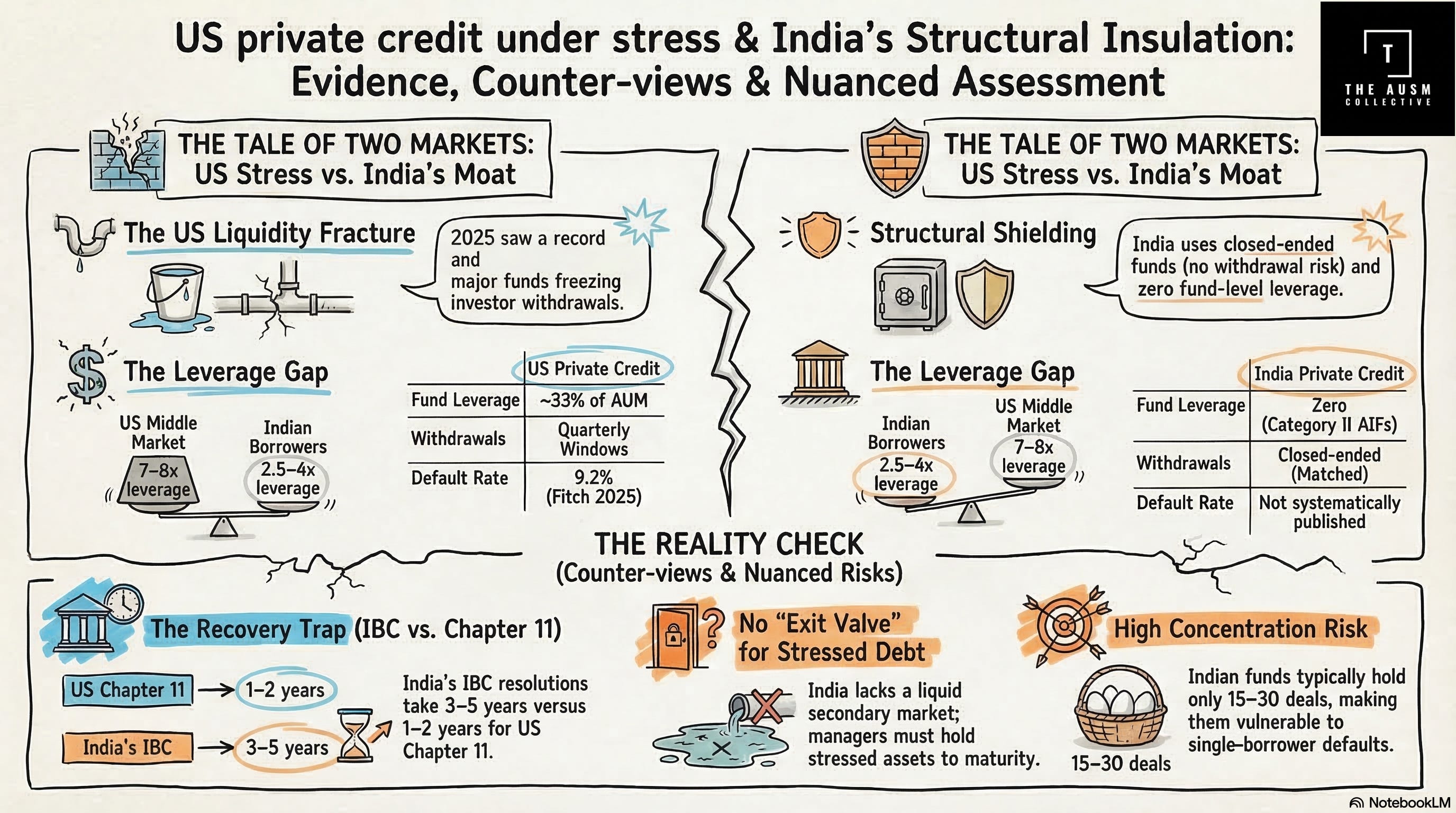
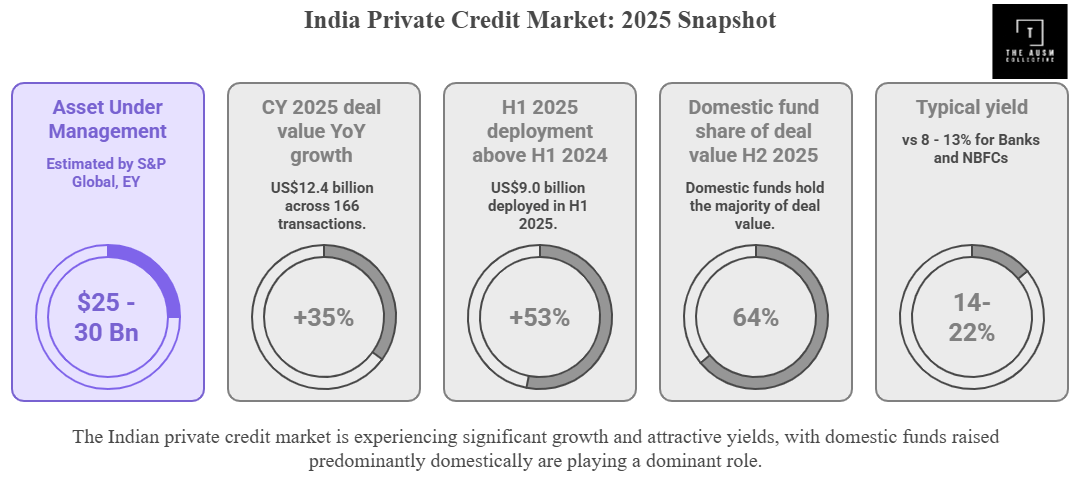
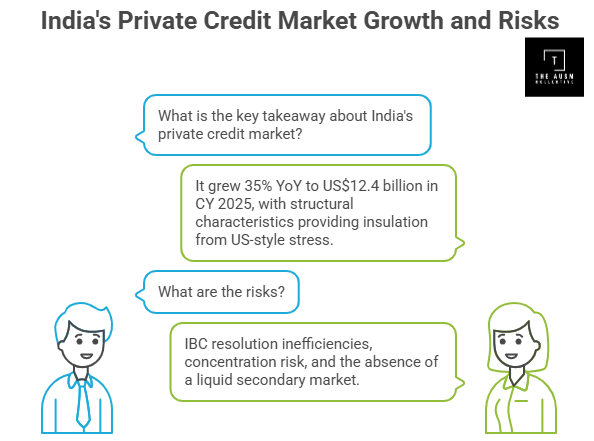
India’s private credit market grew 35% YoY to US$12.4 billion in CY 2025 (EY). Its structural characteristics — lower leverage, closed-ended fund structures, and real-asset focus — provide meaningful insulation from US-style stress. However, IBC resolution inefficiencies, concentration risk at current fund sizes, and the absence of a liquid secondary market are material risks that deserve equal attention.
Section 1: US Private Credit — Current State of Stress
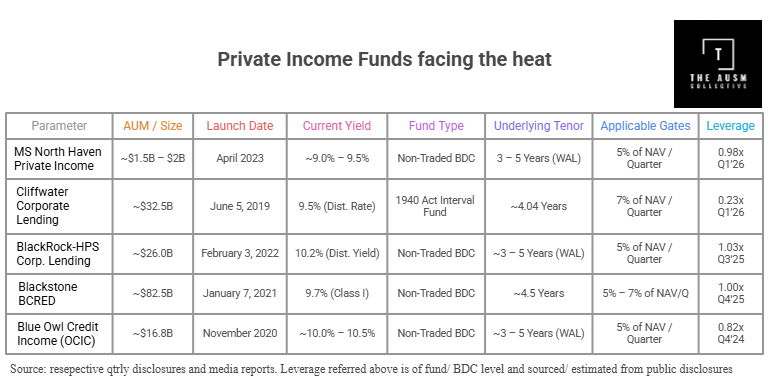
The stress in US private credit is not a single event but a confluence of structural vulnerabilities that have been building since 2022. The following data points frame the severity of the situation. But which are the funds who led the dice to roll.
1.1 Record Default Rates
Fitch Ratings’ PMR portfolio — which tracks 302 US companies with outstanding private credit debt — recorded a 9.2% default rate in 2025, covering 38 defaults among 28 distinct borrowers. This follows the previous record of 8.1% in 2024. The Fitch PMR measure, which includes distressed debt exchanges (not just bankruptcy filings), is structurally higher than broadly syndicated loan (BSL) default rates (4.5% in 2025), reflecting the propensity of private lenders and sponsors to pursue collaborative restructurings.
The size-stratified picture is more alarming: issuers with EBITDA of US$25 million or less recorded a 15.8% default rate, while those with EBITDA above US$100 million had a rate of only 4%. This bifurcation matters because the lower middle market — the bread-and-butter segment for many private credit funds — is experiencing disproportionate stress.
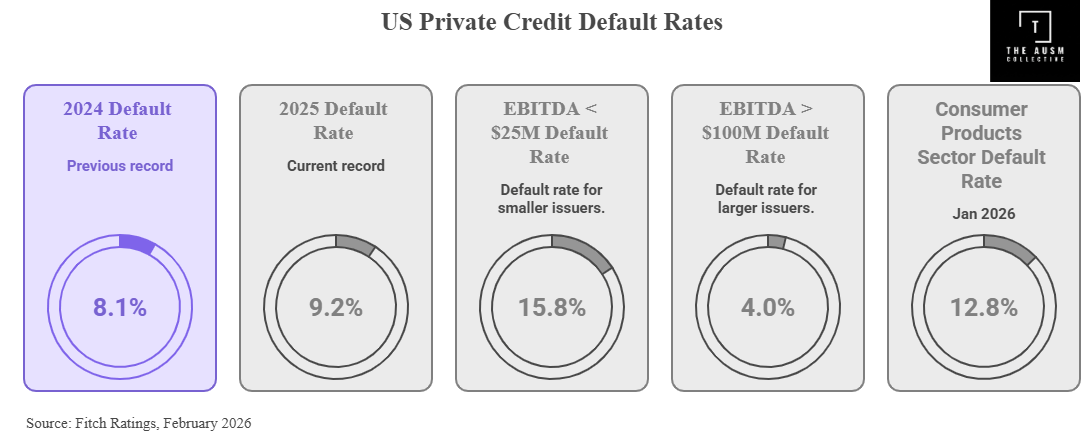
Note: Broader market indices such as the Proskauer Private Credit Default Index (which tracks $144.5 billion in senior-secured and uni-tranche loans) report lower headline rates — 2.46% in Q4 2025 — reflecting differences in methodology, portfolio composition, and whether distressed exchanges are included. The discrepancy between indices underscores the opacity of the asset class, a structural concern in itself.
1.2 Withdrawal Freezes and Markdowns: The Liquidity Fracture
The more visible and market-moving signal has been the freezing of withdrawals across major US private credit vehicles:
• Blue Owl Capital permanently halted investor redemptions at its OBDC II retail private credit fund (November 2025), after redemptions in Q3 2025 nearly doubled to US$60 million (6% of NAV). The fund was forced to sell a US$1.4 billion credit portfolio spanning 128 companies across 27 industries, including software companies facing AI-disruption risk.
• Cliffwater’s flagship US$33 billion private credit vehicle capped redemptions at the regulatory maximum of 7% for Q1 2026, against investor demand of 14% — twice the allowable limit.
• Morgan Stanley and BlackRock followed with similar withdrawal caps, in what Bloomberg described as among the starkest examples of private credit funds grappling with redemption pressure.
JPMorgan Chase has also initiated markdowns on software-linked loans deemed vulnerable to AI disruption, restricting further collateralised lending tied to those portfolios. While this has not triggered systemic margin calls, it signals a tightening of the credit-on-credit ecosystem that has underpinned the sector’s growth.
1.3 Structural Drivers of US Stress
Four structural features of the US market created the conditions for current stress:
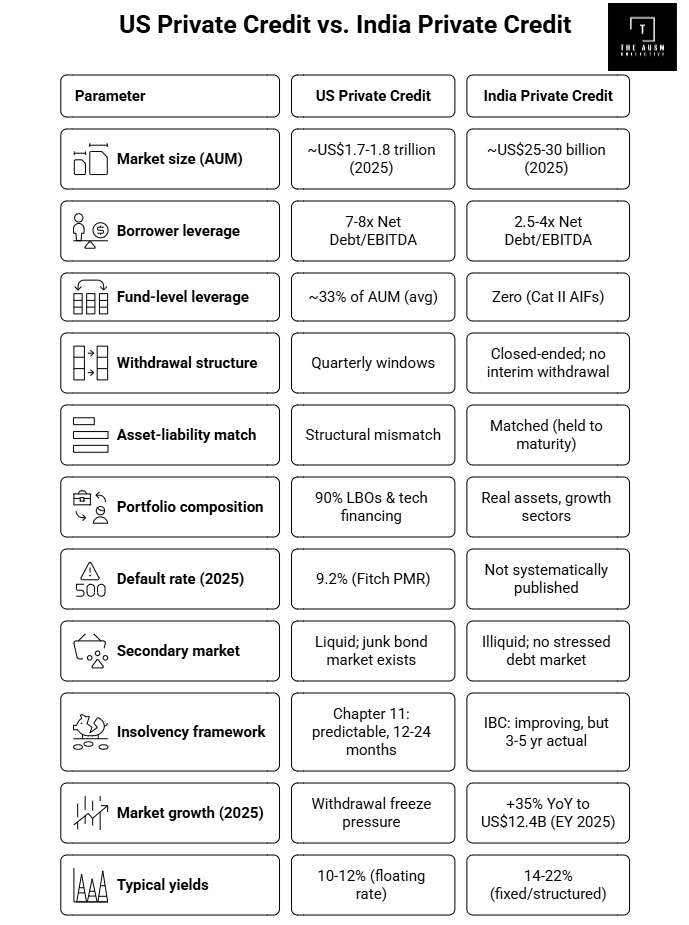
High leverage at borrower level: US mid-market private credit borrowers carry 7-8x Net Debt/EBITDA, with interest coverage ratios declining to approximately 1x as floating-rate loans repriced higher during the ‘higher for longer’ rate environment.
Fund-level leverage: US credit BDCs and interval funds carry average fund-level leverage of approximately 33% of AUM (S&P Global Ratings Research). In a scenario of rising defaults and withdrawal pressure, this leverage amplifies losses and reduces recovery rates for investors.
Asset-liability mismatch: Most US private credit vehicles offer quarterly withdrawal windows. Since underlying loan portfolios are illiquid and typically held to maturity, a surge in redemption requests creates a structural mismatch — the very dynamic now playing out.
Concentration in leveraged tech: Over 90% of US private credit is concentrated in leveraged buyouts and conduit financing for technology companies. The rise of AI as a disruptive force has simultaneously eroded the fundamental credit quality of software-sector borrowers and sparked a flight of investors from the asset class.
Section 2: The Domestic thesis — Why India Is Insulated
It is argued that there are four basic structural differentiators that insulate India’s private credit market from the stress afflicting US counterparts.
2.1 Lower Leverage at Portfolio Companies
Indian mid-market corporate leverage stands at approximately 2.5-3.5x Net Debt/EBITDA, compared to 7-8x in US mid-market private credit. Transaction leverage in India runs at roughly 4x versus 7-8x in the US. This lower leverage provides a greater margin of safety in the event of EBITDA deterioration, reducing the probability of covenant breach and default.
2.2 Absence of Fund-Level Leverage
Indian AIFs operating as Category II funds are prohibited from using leverage at the fund level. This stands in sharp contrast to US credit vehicles, where average fund-level leverage is approximately 33% of AUM. In a default scenario, US fund-level debt holders have priority over investor payouts — materially reducing recovery rates. Indian investors face no such subordination.
2.3 No Asset-Liability Mismatch
Indian private credit funds are closed-ended, with investors unable to withdraw capital before fund maturity. This eliminates the structural liability mismatch that has triggered US fund freezes. Because liabilities are matched to asset maturities, Indian fund managers are not forced sellers of illiquid positions to meet redemption calls. Investments are typically held to maturity, preserving capital and avoiding distressed-sale discounts.
2.4 Resilient Portfolios of Real Assets
Indian private credit finances working assets and operating businesses across growth sectors — real estate, infrastructure, renewable energy, healthcare, and manufacturing. This contrasts with the US, where over 90% of private credit is concentrated in leveraged buyouts and technology-sector conduit financing. Investment in strategically important sectors with tangible assets provides stronger recovery prospects in stress scenarios and greater fundamental portfolio resilience.
Section 3: Counter-Perspectives and Nuanced Qualifications
While the above thesis is broadly sound, several counter-perspectives deserve serious consideration. The following analysis draws on independent market views and investor commentary to stress-test the India insulation argument.
3.1 Portfolio Concentration: The Size and Scale Counterargument
The Claim: US Funds Have Worrying Over-Diversification (100-150 Deals)
A case can be made that US funds, with portfolios of 100-150 deals, are better diversified than their Indian counterparts. Indian credit funds, still at an early stage of scale, tend to have 15-30 deals per fund. If we aggregate Indian funds with similar strategies, the cumulative number of deals may rival a single US fund — but concentration at the individual fund level remains high.
Both the US and Indian funds follow single-borrower and sectoral concentration limits prescribed by regulators (SEBI in India; SEC in the US for BDCs). However, given that India’s private credit AUM is approximately US$25-30 billion compared to the US market of over US$1.7 trillion, a single large deal — such as Shapoorji Pallonji’s US$3.14 billion transaction in H1 2025 — can represent an outsized proportion of market volume. As the market matures and fund sizes grow, diversification will naturally improve, but this remains a current-state risk.
From the point of view of an investor, there is an increasing concentration of deals at investor level where a typical investor (High Networth Investor or Family Office or Institutional) have exposures across multiple private credit funds, who have many common portfolio companies even in a < $25 million deals. It actively carries risk of contagion in case of default in the portfolio or even in case the investor faces issues of liquidity crunch. While it may not withdraw, but it can surely request for reduced commitments.
- View for investors
3.2 The Leverage Debate: Is India Really More Conservative?
The traditional leverage comparison deserves scrutiny.
The 2.5-3.5x Net Debt/EBITDA cited for India versus 7-8x in the US is directionally accurate but requires important qualifications:
Market depth and exit optionality differ fundamentally. The US is a liquid market even for junk bonds — exits, even at a discount, are operationally feasible. In India, there is effectively no secondary market for stressed private credit debt. The absence of exit optionality means that a 3-4x leveraged Indian borrower that defaults offers fewer recovery levers than a 6-7x US borrower where secondary market exits, distressed debt funds, and capital markets provide multiple resolution pathways.
The Debt/EBITDA metric in the US is applied to more mature, cash-flow-generative businesses. In India, many borrowers are in capital-intensive growth phases with EBITDA that is not yet stabilised. A company at 3-4x leverage with volatile EBITDA may carry more effective credit risk than a mature US company at 5-6x with stable, predictable cash flows. On a debt-to-stable-EBITDA basis, the gap between the two markets may be narrower than headline leverage ratios suggest.
Fund-level leverage has a separate dimension from borrower leverage. It is possible for a US fund to create a leverage wrapper at the fund level (adding 1x to portfolio - level debt) without necessarily creating distress at individual portfolio companies. This means the fund-level stress and the investee-company stress are not perfectly correlated and should be evaluated independently, specially in advance/ liquid markets.
3.3 Asset Cover and IBC vs. Chapter 11: A Critical Difference
India’s strong asset cover story is real — but the recovery mechanism is not.
Indian private credit is predominantly structured against tangible assets — real estate, operating businesses, renewable energy infrastructure. Asset cover ratios are typically tighter and more conservatively structured than in the US. However, the value of asset cover is only as good as the insolvency framework that enforces it.
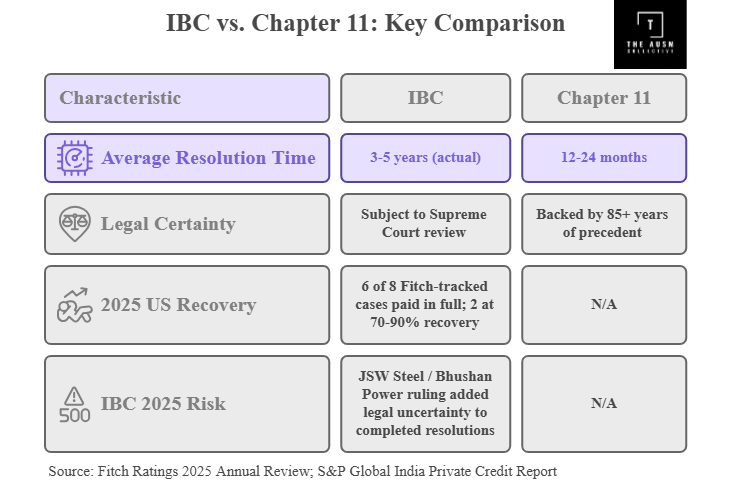
Chapter 11 (US) and the Insolvency and Bankruptcy Code (IBC, India) are as different as day and night in terms of predictability, speed, and outcomes:
• Chapter 11 provides a structured, time-bound process (typically 12-24 months) with strong creditor protections, debtor-in-possession (DIP) financing, and robust judicial precedent. Recovery rates for first-lien US private credit lenders have remained relatively strong — in 2025, six of eight resolved Fitch-tracked cases resulted in full paydown, with the remaining two seeing estimated recoveries of 70-90%.
• India’s IBC, while transformative relative to pre-2016 frameworks, still suffers from significant delays and legal uncertainty. The Supreme Court’s May 2025 decision to invalidate JSW Steel’s acquisition of Bhushan Power & Steel — completed through IBC in 2021 — highlights the systemic unpredictability that persists. Average IBC resolution timelines remain well above the 330-day CIRP mandate, often stretching to 3-5 years.
• The assets available for recovery in India are also a function of economic development. India’s old business houses have tangible assets to pledge, but as the market expands to newer-economy borrowers — technology, digital infrastructure, healthcare — the shift toward cash-flow-based lending will erode the asset-cover advantage over time.
3.4 Two Things India Gets Genuinely Right
Notwithstanding the above qualifications, two aspects of the Indian private credit market deserve genuine appreciation:
• Closed-ended fund structures eliminate interim liquidity risk. Unlike US interval funds with quarterly withdrawal windows, Indian AIFs categorically do not offer interim liquidity. This is a structural advantage, not merely a regulatory constraint. It ensures that Indian funds are never forced sellers and are never subject to the liquidity death-spiral that has afflicted Blue Owl, Cliffwater, and Morgan Stanley.
• No fund-level leverage for Category II AIFs. SEBI categorically prohibits leverage at the fund level for most Indian private credit vehicles (Category II AIFs). This means Indian investors are not subordinated to fund-level debt in recovery scenarios — a material structural advantage over the US model where fund-level leverage averages 33% of AUM.
Section 4: Side-by-Side Comparison
Section 5: Residual Risks and Conclusion
5.1 Risks That Deserve Investor Attention in India
The insulation argument does not imply immunity. The following risks are specific to the Indian market and should be monitored:
• IBC uncertainty: The 2025 Supreme Court ruling on JSW Steel/Bhushan Power is a reminder that legal resolution risk in India remains elevated. As deal sizes grow, creditors need greater comfort on enforcement timelines.
• Absence of a secondary market: The illiquidity of Indian private credit is a double-edged sword. While it eliminates the withdrawal-freeze risk, it also means that fund managers have no price discovery mechanism and no exit valve in a stress scenario beyond holding to maturity and relying on IBC.
• Concentration at current market size: As India’s market grows — and it is expected to reach US$30-40 billion in AUM within 2-3 years — individual fund concentration will naturally diminish. But today, a single large deal can meaningfully skew fund-level outcomes.
• Investor concentration in a single strategy: As the market participants increase and the white space of Banks and NBFCs been away gets populated again by them with the recent change in regulations, there will be pressure on high yielding deal flow, increasing the chance of overlap of same borrower/ deal in multiple investee funds, may be same or uni-tranche structures. Investors should be cautious of the same.
• Transition from asset-backed to cash-flow lending: As traditional collateral-rich sectors mature, private credit in India will inevitably move toward cash-flow-based lending in newer sectors. This structural shift, if not managed with enhanced credit discipline, could erode the current asset-cover advantage.
• PIK (Payment - In - Kind) and interest deferral: While not yet a systemic concern in India, there are early signs of PIK-structured credit in growth situations. If macro conditions deteriorate, PIK loans can mask underlying credit stress — as they have done in the US, where PIK income now accounts for over 8% of BDC income, double the pre-COVID level.
5.2 Conclusion
The thesis that India’s private credit ecosystem is structurally insulated from US-style stress is well-founded and supported by data. The four pillars — lower borrower leverage, zero fund-level leverage, closed-ended structure, and real-asset portfolio composition — are genuine and material differentiators.
However, a more complete assessment requires acknowledging that the IBC remains a work in progress, the absence of a secondary market is a constraint as much as a protection, and the leverage advantage is partly a function of market maturity rather than inherently superior credit discipline.
Investment Conclusion
India’s private credit ecosystem offers a structurally superior risk-return profile versus its US counterpart at this point in the credit cycle. Lower leverage, no fund-level debt, closed-ended structures, and real-asset portfolios provide a genuine margin of safety. Investors should, however, demand transparency on IBC resolution track records, single-borrower concentration, and the evolution of fund strategies toward cash-flow-based lending as the market matures.
The stress in the US market is not a reason for complacency in India — it is a roadmap of the structural risks to avoid.
Sources: Fitch Ratings, S&P Global, Reuters, EY India Private Credit Reports, PwC, J.P. Morgan Private Bank, Proskauer Private Credit Index.
Disclaimer
This material is for informational purposes only and relates to general market commentary. It does not constitute investment advice, offer, solicitation, or recommendation to buy or sell any securities or financial product. Views expressed are those of the authors based on publicly available sources and are subject to change without notice.
Excellent graphic says it all.